

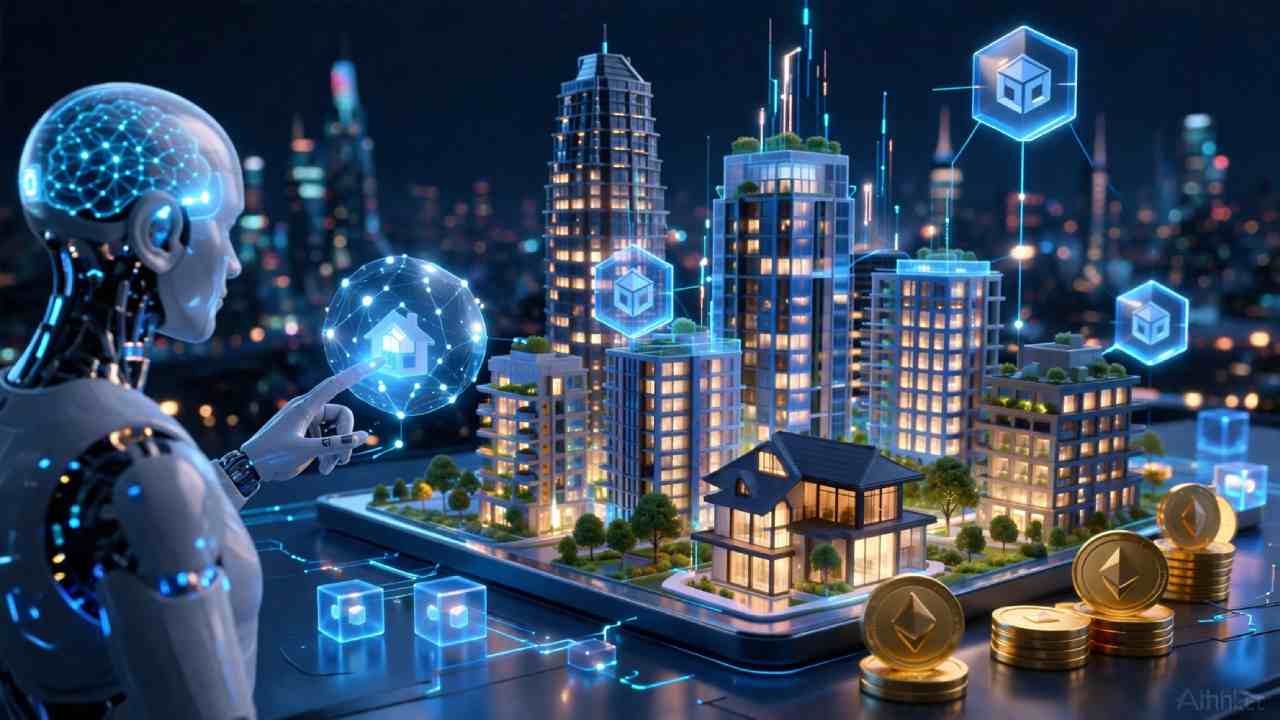
Real estate tokenization is emerging as a structural transformation in property investment, where physical assets are converted into digital tokens recorded on blockchain networks. When combined with artificial intelligence, this model evolves further into a dynamic system that enhances valuation accuracy, automates operations, and expands global accessibility.
This convergence of AI and blockchain is reshaping how property ownership is distributed, how investments are managed, and how liquidity is unlocked from traditionally illiquid assets. Instead of relying solely on intermediaries, investors and asset owners can now interact within transparent, automated ecosystems powered by smart contracts and data-driven intelligence.
Understanding Real Estate Tokenization
Real estate tokenization refers to the process of representing ownership rights of a property as digital tokens on a blockchain. These tokens can represent fractional ownership, enabling investors to purchase smaller portions of high-value assets rather than acquiring entire properties. Each token typically represents a share of the underlying asset, and ownership is recorded immutably on a distributed ledger. This eliminates many inefficiencies associated with traditional property transactions, such as paperwork delays, high entry barriers, and dependence on centralized authorities. By integrating blockchain infrastructure, tokenized real estate ensures transparency, traceability, and programmable ownership. Smart contracts enforce rules related to transfers, dividends, and governance, reducing the need for intermediaries.
The Role of AI in Transforming Tokenized Real Estate
1. AI-Driven Property Valuation
Accurate valuation is critical in real estate tokenization. AI algorithms can analyze large datasets—including historical pricing, location trends, infrastructure development, and macroeconomic indicators—to generate precise and dynamic valuations.
Unlike traditional appraisal methods, which may rely on periodic evaluations, AI continuously updates property values based on real-time market conditions. This ensures that token prices reflect current asset performance, improving investor confidence and market efficiency.
2. Predictive Analytics for Investment Decisions
AI enables predictive modeling that helps investors anticipate future trends. By analyzing patterns such as rental yields, occupancy rates, and regional growth indicators, AI systems can forecast potential returns and risks associated with tokenized properties.
These insights are particularly valuable in global markets, where investors may not have direct access to on-the-ground information. AI bridges this gap by providing data-driven forecasts that support informed investment decisions.
3. Automated Compliance and Risk Assessment
Regulatory compliance is a major challenge in cross-border real estate investment. AI simplifies this process by automating KYC (Know Your Customer), AML (Anti-Money Laundering), and investor verification procedures.
Machine learning models can detect suspicious transactions, identify fraud patterns, and ensure compliance with jurisdiction-specific regulations. This reduces operational overhead while increasing trust and security within the tokenization ecosystem.
Enhancing Liquidity Through AI and Tokenization
Liquidity has traditionally been a limitation in real estate investment. Properties are illiquid assets that require significant time and effort to buy or sell. Tokenization addresses this by enabling fractional ownership, while AI further enhances liquidity by optimizing market dynamics. AI systems can analyze supply and demand trends to suggest optimal pricing strategies for tokenized assets. They can also match buyers and sellers more efficiently by predicting investor preferences and behavior patterns. Platforms inspired by decentralized liquidity protocols like Uniswap can benefit from AI-driven pricing models, ensuring smoother and more efficient asset exchanges in secondary markets.
AI-Powered Investor Personalization
One of the most powerful applications of AI in real estate tokenization is personalized investment experiences. AI systems can analyze investor profiles, including risk tolerance, investment goals, and portfolio preferences, to recommend suitable tokenized assets. This level of personalization increases engagement and conversion rates by delivering tailored opportunities to each investor. For example, conservative investors may be guided toward stable, income-generating properties, while risk-tolerant investors may be introduced to high-growth assets. Personalized dashboards, recommendation engines, and automated portfolio suggestions create a seamless and intuitive investment experience.
Smart Contracts Enhanced by AI
Smart contracts are the foundation of tokenized ecosystems, automating processes such as ownership transfer, dividend distribution, and compliance enforcement. When combined with AI, these contracts become even more powerful. AI can dynamically adjust contract parameters based on market conditions, asset performance, or regulatory changes. For instance, rental income distributions could be automatically adjusted based on occupancy rates or market demand. This adaptability transforms static smart contracts into intelligent, responsive systems that optimize outcomes for both investors and asset managers.
AI for Fraud Detection and Security
Security remains a top priority in tokenized real estate platforms. AI enhances security by identifying anomalies, detecting fraudulent activities, and monitoring transactions in real time. Machine learning algorithms can analyze transaction patterns to detect unusual behavior, such as unauthorized transfers or suspicious trading activity. These systems provide an additional layer of protection beyond traditional security protocols. Combined with blockchain’s immutability, AI-driven security systems create a highly secure and trustworthy investment environment.
Data-Driven Market Insights
AI thrives on data, and real estate tokenization generates vast amounts of it. From investor activity to property performance metrics, every interaction can be analyzed to generate actionable insights.
These insights help platform operators:
- Identify emerging investment trends
- Optimize asset allocation strategies
- Improve user engagement
- Forecast market demand
By transforming raw data into meaningful insights, AI empowers stakeholders to make informed, strategic decisions.
AI and Portfolio Diversification
Diversification is a key principle of investment strategy, and AI enhances this by identifying correlations between different asset classes. AI algorithms can recommend diversified portfolios that balance risk and return across multiple tokenized properties. For example, an investor may hold tokens representing residential real estate, commercial properties, and infrastructure projects across different regions. AI ensures that these assets are balanced to minimize risk exposure while maximizing returns.
Enhancing User Experience with AI Interfaces
User experience plays a crucial role in attracting and retaining investors. AI-powered interfaces provide intuitive dashboards, predictive insights, and automated guidance. Features such as chatbots, virtual assistants, and voice-based interfaces help users navigate complex investment processes. These tools make real estate tokenization more accessible, even for non-technical users. By simplifying interactions, AI reduces barriers to entry and encourages broader participation in tokenized markets.
AI in Secondary Market Optimization
Secondary markets are essential for providing liquidity to tokenized assets. AI enhances these markets by analyzing trading patterns, predicting price movements, and facilitating efficient order matching. AI algorithms can also identify arbitrage opportunities and optimize pricing strategies to ensure fair market value. This creates a more dynamic and responsive trading environment.
Challenges in AI-Enabled Tokenization
Despite its advantages, integrating AI into real estate tokenization presents several challenges:
- Data privacy and security concerns
- Regulatory uncertainty around AI and blockchain
- Complexity in model training and maintenance
- Dependence on high-quality data inputs
- Integration with existing financial systems
Addressing these challenges requires careful planning, robust infrastructure, and adherence to global compliance standards.
Future Outlook of AI-Driven Real Estate Tokenization
The future of real estate investment will likely be defined by deeper integration of AI and blockchain technologies. Emerging trends include:
- Autonomous investment platforms powered by AI
- AI-driven decentralized autonomous organizations (DAOs) managing real estate assets
- Advanced predictive models for global real estate markets
- Cross-chain interoperability for tokenized assets
- AI-enhanced identity and verification systems
These developments will further democratize access to real estate investments, enabling broader participation and more efficient markets.
Conclusion
AI-enabled real estate tokenization represents a transformative evolution in digital property investment. By combining the transparency and security of blockchain with the intelligence and automation of AI, this approach creates a highly efficient, data-driven investment ecosystem. From valuation and compliance to liquidity and personalization, AI enhances every aspect of tokenized real estate. As technology continues to evolve, the integration of AI will play a defining role in shaping the future of property investment, making it more accessible, transparent, and efficient for investors across the globe.