

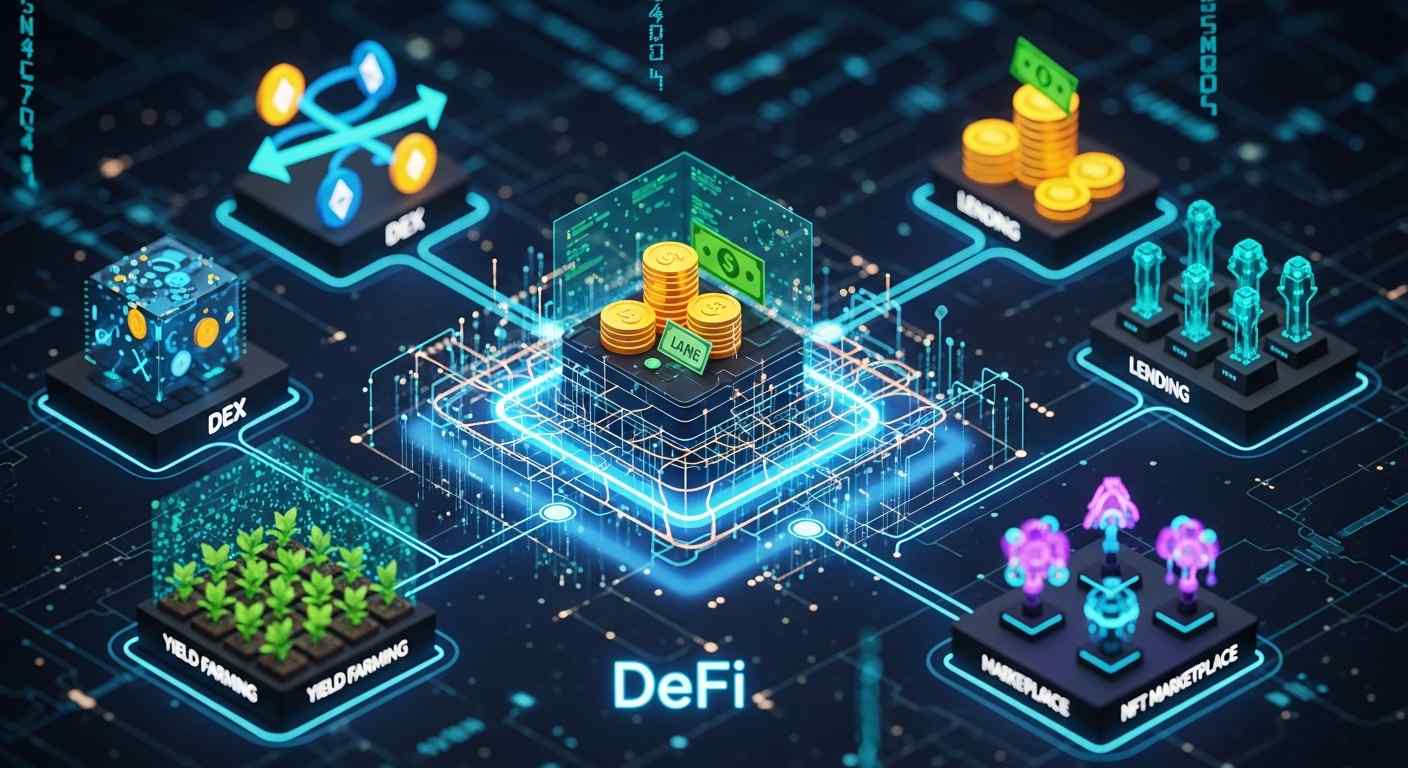
Decentralized finance, or DeFi, is a blockchain-based financial system that lets people and businesses access services such as trading, lending, borrowing, payments, and yield generation without relying on a traditional bank or broker as the central operator. Ethereum describes DeFi as a set of financial products and services that are open to anyone with an internet connection, while Chainlink defines it as an ecosystem of permissionless and transparent financial services built on blockchains.
That open architecture is what makes DeFi important. Instead of financial logic being controlled inside a private institution’s database, DeFi applications run through smart contracts on public blockchains. Those contracts define how assets move, how collateral is managed, how liquidity is provided, and how users interact with the system. Ethereum also notes that DeFi markets are effectively always open and operate through code that can be inspected, which is one reason the model is often presented as more transparent than closed financial infrastructure.
For beginners, DeFi can look confusing because it combines finance, software, cryptography, and market design in one system. For businesses, it can seem like a mix of opportunity and risk. Both views are correct. DeFi can unlock faster settlement, programmable financial products, and global access, but it also introduces smart contract risk, governance risk, liquidity stress, and operational complexity. The Bank for International Settlements has emphasized that DeFi aims to replicate many core functions of traditional finance while also introducing distinct stability and governance challenges.
What DeFi Actually Is
The easiest way to understand DeFi is to think of it as financial software that runs on a blockchain. In traditional finance, if someone wants to borrow money, exchange currencies, or earn interest, the process usually flows through a bank, exchange, or payment company that controls the records and the rules. In DeFi, those rules are embedded in smart contracts, and users interact with them through wallets and decentralized applications rather than through a centralized institution. Ethereum’s DeFi overview and its app directory both frame DeFi in exactly this way: as open applications for lending, borrowing, trading, and earning on crypto assets.
This does not mean DeFi has no intermediating structures at all. In practice, there are still interfaces, developer teams, governance groups, token holders, and oracle providers. The BIS has warned that DeFi can create a “decentralisation illusion” because governance and control often remain concentrated in important ways even when the infrastructure is more open than conventional platforms. That is an important point for businesses evaluating DeFi seriously rather than romantically.
At its core, DeFi is built around a few simple ideas: programmable assets, open ledgers, self-custodied wallets, and financial logic executed by smart contracts. Once those pieces are combined, it becomes possible to build decentralized exchanges, lending markets, derivatives systems, asset management tools, stablecoins, and payment networks that do not need a bank to run each step manually.
The Building Blocks Behind DeFi
DeFi only works because several technical layers operate together. The first is the blockchain itself. Ethereum remains the most recognized foundation for DeFi because it supports programmable smart contracts and a large ecosystem of applications, wallets, and developer tools. Ethereum also highlights that many Layer 2 networks are now built on top of it to reduce fees and improve speed while benefiting from Ethereum’s broader security model.
The second building block is smart contracts. These are programs that automatically execute financial logic when users interact with them. A lending protocol, for example, can accept collateral, issue a loan, track repayment conditions, and liquidate positions if thresholds are breached. The contract does not rely on a human employee to do those tasks one by one. It follows coded rules that apply consistently to all users.
The third building block is the wallet. In DeFi, the wallet acts as the user’s access point, signature tool, and asset container. Instead of opening an account with a bank, the user connects a wallet to an application and authorizes transactions directly. This is one reason DeFi is described as permissionless, though actual access can still be shaped by geography, interface design, token costs, and technical literacy.
A fourth critical component is the oracle. Blockchains cannot natively verify many real-world facts such as off-chain asset prices, weather data, or benchmark rates. Chainlink’s education materials explain that DeFi applications depend on secure external data feeds to power many advanced use cases. Without oracles, large parts of lending, derivatives, and tokenized asset infrastructure would be far less useful.
How DeFi Works in Practice
DeFi works by replacing institutional workflows with smart contract systems. Imagine a user wants to borrow against crypto holdings. In traditional finance, that process may involve application review, a custodian, underwriting, compliance checks, and internal ledgers. In DeFi, the user deposits collateral into a smart contract, and the protocol determines borrowing power according to predefined parameters. If the collateral ratio remains healthy, the loan continues. If it falls below the threshold, the position may be liquidated automatically. This is one of the clearest examples of how DeFi substitutes manual intermediation with programmable execution.
The same principle applies to trading. Instead of sending orders to a centralized exchange operator, users can trade through decentralized exchanges that rely on smart contracts and liquidity pools. Ethereum’s app listings identify trading and swapping as core DeFi functions, and Coinbase’s overview of DEXs describes them as peer-to-peer marketplaces without the conventional centralized operator found in traditional exchanges.
Yield generation also follows this logic. Users can lend assets, stake tokens, provide liquidity, or deposit into automated strategies that move funds according to on-chain rules. The result is a system where financial products are modular. One protocol may handle borrowing, another may provide price feeds, another may supply liquidity, and another may tokenize a deposit receipt. Chainlink refers to this as the DeFi ecosystem’s infrastructure layer, where products build on top of one another in a composable way.
In a real-world defi development company workflow, this composability matters because a product is rarely built from one contract alone. Teams often have to design how asset custody, pricing, governance, risk controls, and user interfaces interact across multiple on-chain modules.
Major DeFi Use Cases
The most established DeFi use case is decentralized trading. Users can swap assets directly from their wallets through protocols that match orders or use liquidity pools. This lowers reliance on centralized custodians and allows continuous access to markets, though it also introduces price impact, slippage, and MEV-related concerns. Ethereum’s DeFi resources and application listings both highlight token trading as a foundational function of the ecosystem.
Lending and borrowing are equally important. Users can deposit crypto to earn yield or borrow against collateral without applying through a bank. This model can expand access and shorten settlement times, but it usually requires overcollateralization, which limits its resemblance to conventional consumer credit. The BIS has pointed out that DeFi reproduces familiar financial activities, but often in highly collateralized and crypto-native forms.
Stablecoins are another key use case because they provide a less volatile unit of account inside crypto markets. Many DeFi transactions are denominated in dollar-linked tokens rather than in more volatile assets. Without stablecoins, DeFi markets would be significantly less usable for trading, settlement, and treasury functions. BIS research on DeFi and crypto functions also identifies stablecoins as a central part of the ecosystem’s infrastructure.
Asset management is growing as well. Some DeFi protocols act like automated portfolio managers or liquidity allocators. Ethereum’s institutional DeFi resources point to this emerging category, where protocols can create and manage customizable pools or optimize allocation strategies across on-chain venues.
Why DeFi Appeals to Beginners and Businesses
For beginners, the appeal of DeFi usually starts with access. DeFi applications can be used without opening a conventional bank account, and many services are available around the clock. Ethereum explicitly emphasizes that its DeFi ecosystem is open 24/7 and accessible to anyone with an internet connection. That does not remove all barriers, but it does reduce dependence on branch networks, business hours, and centralized platform approval.
Another attraction is transparency. Smart contracts can often be inspected, and transactions settle on public ledgers. That means users can verify many system rules and outcomes directly instead of relying only on institutional statements. For businesses, that auditability can be valuable in treasury workflows, tokenized asset systems, or automated settlement processes where counterparties want a shared record of execution.
Businesses are also interested because DeFi introduces programmable finance. A payment can be tied to a condition, a treasury policy can be automated, a marketplace can settle without a clearinghouse, and a tokenized asset can carry embedded transfer rules. This is where defi development services become commercially relevant: companies are not just buying code, they are exploring ways to create faster, more transparent, and more composable financial products using blockchain infrastructure.
The Size and Momentum of the DeFi Market
DeFi is no longer a tiny experimental niche. DefiLlama says it tracks more than 7,000 protocols across more than 500 chains and provides real-time data on value locked, fees, revenue, and yields across the ecosystem. That scale alone shows how broad the DeFi landscape has become.
This does not mean all of that activity is equally strong or sustainable, but it does show that DeFi has evolved from a single-chain experiment into a large multi-chain market. The growth of liquid staking, stablecoin-based products, DEX trading, and automated yield systems suggests that DeFi is increasingly functioning as a layered financial stack rather than as a collection of unrelated apps. Chainlink’s ecosystem analysis makes the same point by describing DeFi as a network of interdependent infrastructure, products, and market dynamics.
Risks Businesses and Beginners Should Not Ignore
DeFi’s openness does not eliminate risk. The first and most obvious issue is smart contract vulnerability. If the contract is flawed, funds can be lost, frozen, or drained. Because DeFi often manages assets directly, software bugs can have immediate financial consequences.
The second risk is liquidity and market stress. DeFi protocols can depend heavily on collateral values, incentives, and user confidence. If token prices drop sharply or liquidity dries up, lending systems, stablecoin pegs, and liquidity pools can come under pressure. The BIS has repeatedly pointed to leverage, liquidity mismatches, operational fragilities, and interconnectedness as important DeFi vulnerabilities.
A third issue is governance concentration. Even when a system is marketed as decentralized, a relatively small group may control upgrades, treasury decisions, admin keys, or core parameters. That can create a gap between the rhetoric of decentralization and the reality of operational power.
There is also oracle and dependency risk. If a protocol relies on outside data feeds or other DeFi applications, a failure in one layer can ripple into others. This is one reason DeFi composability is both a strength and a weakness. It enables rapid innovation, but it also increases systemic coupling.
What Businesses Should Evaluate Before Building in DeFi
Businesses should begin with the use case, not the buzzword. The real question is whether DeFi solves a concrete problem better than conventional infrastructure. For some companies, the answer may be yes in areas such as tokenized assets, cross-border settlement, on-chain treasury tools, or automated market systems. For others, traditional infrastructure may still be more practical.
The next issue is architecture. A company needs to know which chain it will use, how users will onboard, how identity or compliance requirements will be handled, how contracts will be audited, and what happens if an upgrade or emergency response is needed. Open infrastructure can reduce some forms of dependence, but it increases the importance of technical design and governance discipline.
A serious decentralized finance development company should therefore approach DeFi as risk-managed infrastructure, not just a feature set. Smart contract security, wallet experience, oracle design, governance controls, and legal coordination are all part of whether a DeFi product is usable in the real world.
Conclusion
DeFi works by turning financial services into blockchain-based software. Instead of relying entirely on banks, brokers, and other centralized operators, users and businesses interact with smart contracts that automate lending, trading, payments, asset management, and more. Ethereum and Chainlink both describe DeFi as open, programmable, and transparent financial infrastructure, while BIS research shows that the model also brings significant governance and stability questions that must be taken seriously.
For beginners, the main lesson is that DeFi is not magic. It is finance redesigned through code, wallets, and public ledgers. For businesses, the lesson is that DeFi is not just about crypto speculation. It is about programmable market infrastructure with real potential and real risk. The organizations that benefit most will be the ones that understand both sides clearly.